Source paper: Holistic Optimization - Integrating Agriculture into Mining for Sustainable Value - King, B. (2024)
Mining land does not need to move in a straight line from untouched ground, to extraction, to delayed rehabilitation. This case study explores a different framing: optimise the mine plan and the post-mining land use together, so the schedule deliberately creates conditions for long-term agricultural value while still protecting the economic value of the mining operation.
The source paper, Holistic Optimization - Integrating Agriculture into Mining for Sustainable Value, introduces Holistic Optimisation and Holistic Present Value as a way to extend conventional NPV. The intent is to capture mining cash flow alongside environmental, social, closure, rehabilitation, and agricultural outcomes in one planning objective.
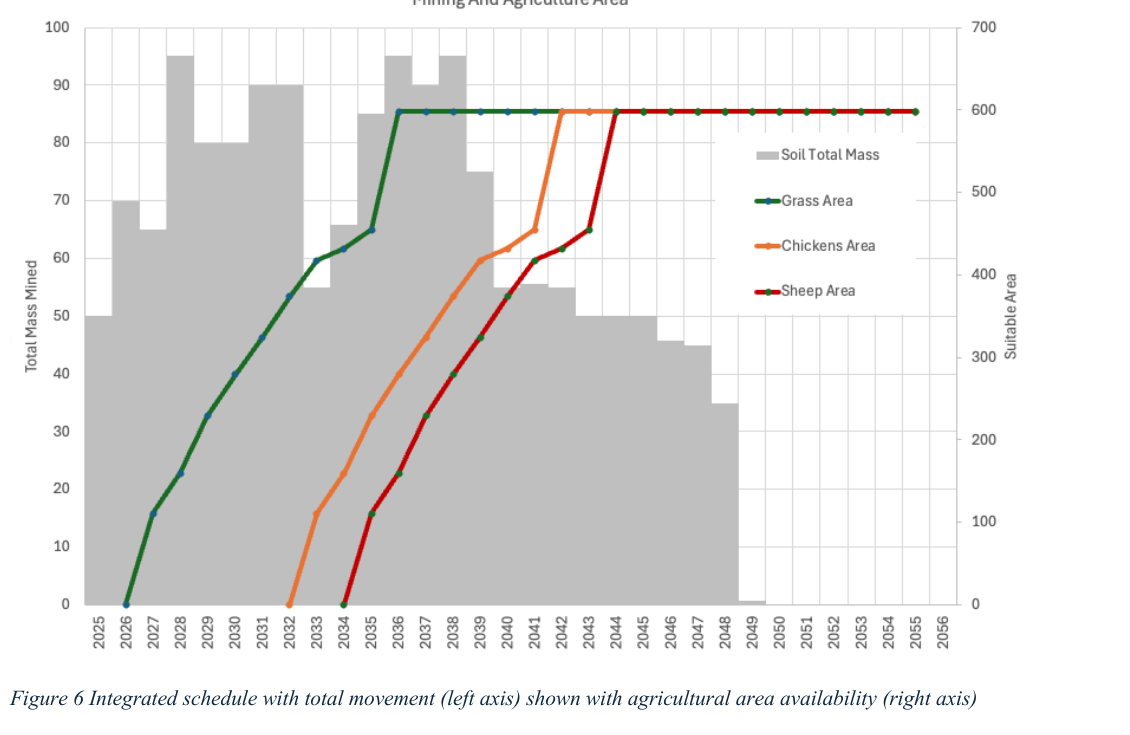
In the proof-of-concept, COMET Strategy modelled agriculture directly inside the mine scheduling problem. The model considered mining sequence, available surface area, waste placement, soil regeneration, water and sunlight availability, agricultural yields, product pricing, and closure value. The agricultural system included grass, egg-laying chickens, and sheep.
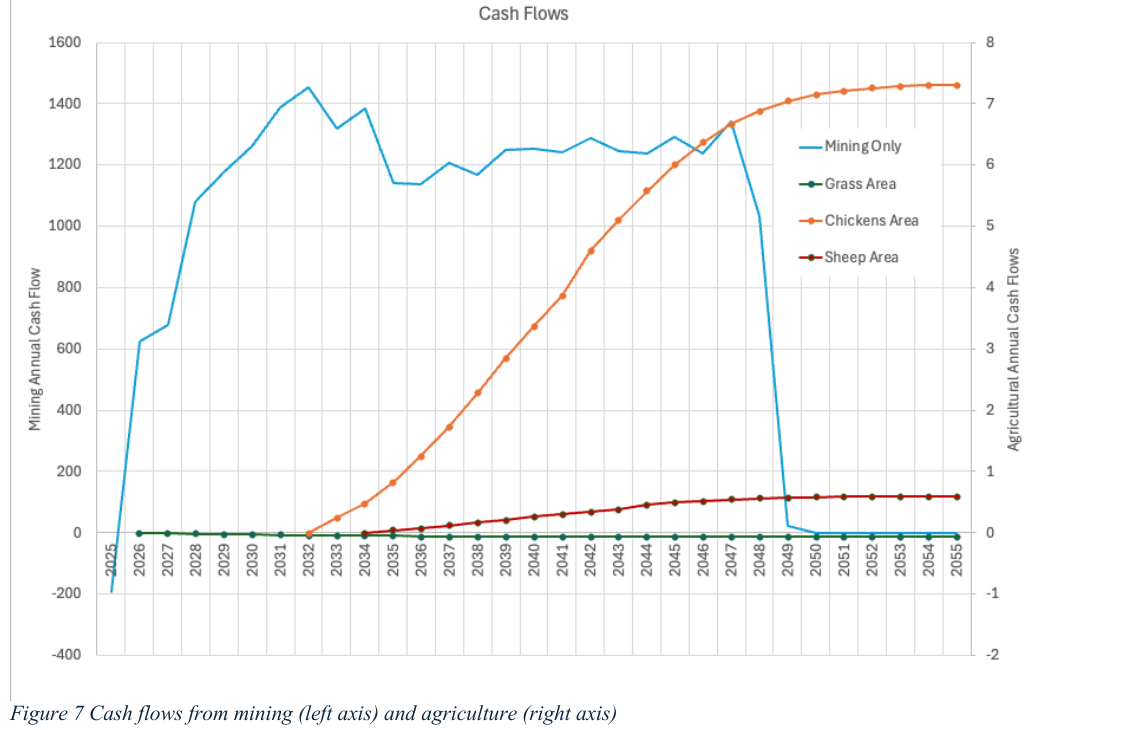
The integrated agriculture case increased Holistic Present Value from USD $9,695 million to USD $9,867 million, an improvement of USD $172 million, or 1.8 per cent. Mine life increased from 23.68 years to 25.00 years. Final value shifted from a USD $10 million closure liability to a USD $68.5 million positive long-term agricultural value.
The important insight is not only the value increase. The schedule changed because the model recognised value in creating agricultural land earlier. Mining accelerated in selected periods to release usable surface area, while cut-off grade behaviour also shifted. This is the kind of non-linear, cross-discipline trade-off that is difficult to preserve in simplified planning methods.
The agricultural value did not dominate the mining value, and the paper is careful to present the work as a proof-of-concept. But it shows that regenerative land use, closure planning, food production, and social value can be framed as part of the optimisation problem rather than treated as an afterthought.
For long-life mines, this creates a different planning question: not simply how to extract the ore body, but how to optimise the full land-use story before, during, and after mining.